Author: Onyx Montes
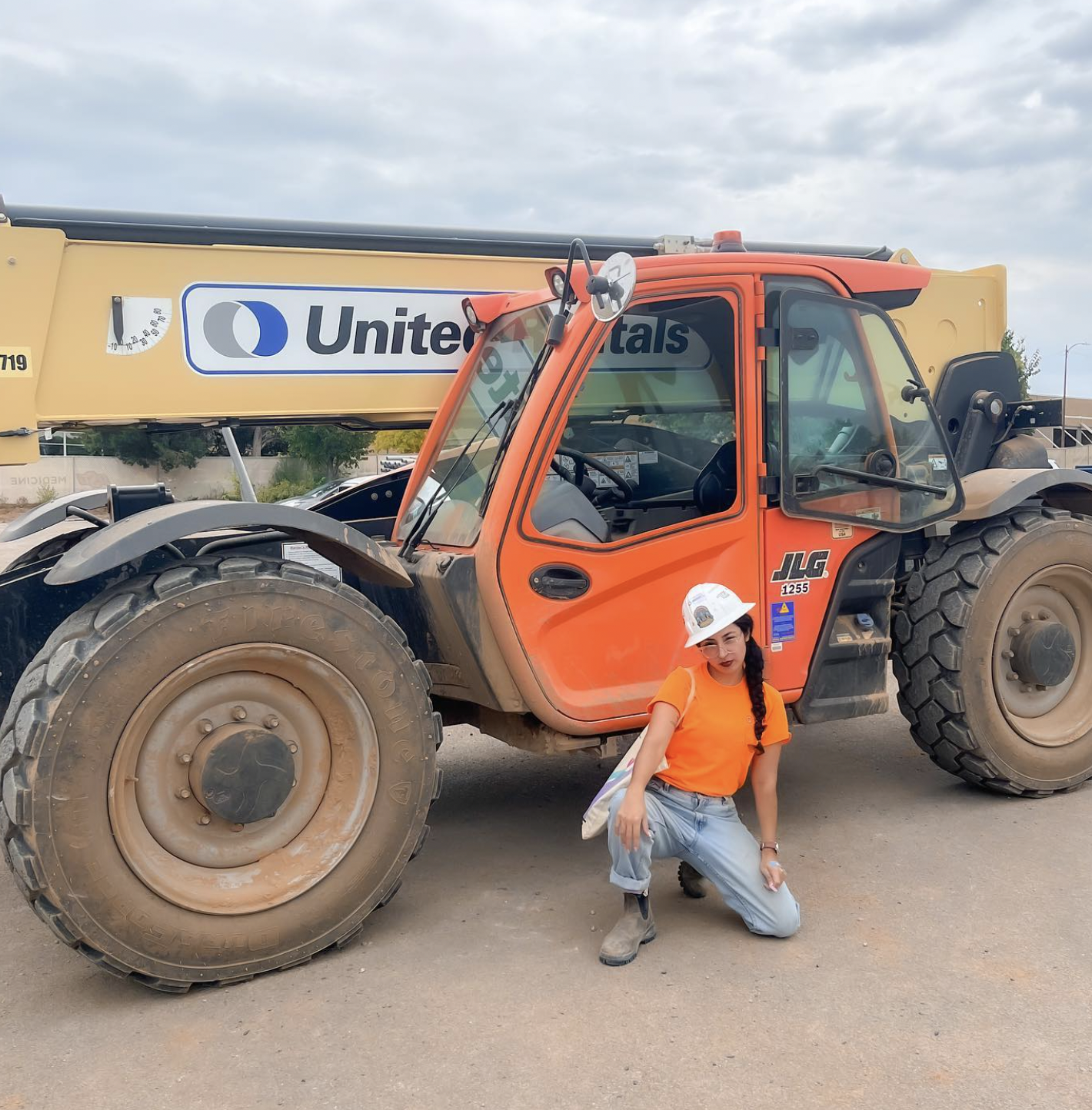
For months, I avoided telling anyone I worked at a construction jobsite. It felt terminally uncool to admit I was a plumber apprentice helping build the new Veterans Hospital in downtown Tulsa, and later a St. Francis hospital site. On my first day I arrived at 5:40 AM without the proper clothing or boots. I had just moved to Oklahoma, I had always worked white collar jobs at the MET and the Art Institute, and I had never stepped foot on a jobsite. I came from museums, social justice, and arts advocacy. That morning felt like a plot twist. It’s what Alice must have felt falling into the rabbit hole.
My coworkers gathered while we waited for attendance. The men stood around chugging energy drinks, spitting tobacco, reeking of sweat, grime, and cigarettes. I took my tote bag, my Stanley cup, and followed my journeyman to the third floor. I was the only girl there.
My work had always centered on expanding how people think. In museums you sometimes hear of leadership going on sabbaticals. To me a sabbatical sounded like a luxury from another era. So I created my own version by taking a career tangent that had nothing to do with my degree. I wanted to enter a trade that would make me a better thinker.
What fascinated me about art history was learning to read images, colors, textures, and brushstrokes as stories tied to history and aesthetics. My career reflected imaginative and creative strengths. I felt less confident in linear, analytical work. I wanted to exercise the part of my brain I neglected, and I was disillusioned by how technology encourages passivity. Staying in and scrolling is easier than waking up at 4:30 AM to calculate pipe angles. We are enticed to consume more and create less. I wanted to use my body and mind in ways I never had.
I prepared for three months in Chicago before moving to Tulsa. I soldered, practiced math, worked with tools, and solved logic puzzles. I knew entering the trades as a leftist woman of color in Oklahoma would be difficult, but I was ready. Every day I woke up at 4:30 AM for ten-hour shifts, soldering copper in summer and layering against winter cold. Plumbing school added seven hours a week. Apprenticeships are intense. Breaks are short. If there is no gas station nearby, you bring your food. Then there are the porta-shitters, tiny plastic cubes that test your dignity, especially on your period and surrounded by Sharpied slurs. You bring your own toilet paper and sanitizer.
One journeyman questioned my ability to read a tape measure.
The hardest part was not the work. It was the culture. As one of the few women in the trade I was hyper-visible and invisible at the same time. I could not casually ride to lunch with coworkers. I struggled to blend in and felt intimidated by their camaraderie and shared hobbies like hunting and shooting. Many coworkers were ex-convicts or recovering from addiction. I respected the trade deeply, but the culture shock was real. I had earned more working remotely in the arts than some blue-collar workers doing backbreaking labor.
Journeymen are supposed to teach apprentices, but you never know who you will get. Some refused to teach me, leaving me to figure things out. Constant reassignments meant I was always starting over. I grew used to being doubted. One journeyman questioned my ability to read a tape measure. The next day I printed blank rulers and asked him to test me. I aced it. Another apprentice mocked me for not lifting a 10-foot cast iron pipe alone, even though it was unsafe. He yelled, “What are you doing here if you can’t carry a pipe?” His meaning was clear. I did not belong.
There were cultural shocks beyond the jobsite. At a union hall meeting the men removed their hats, bowed for prayer, and recited the Pledge of Allegiance. I stayed seated. Staying true to my values mattered more than fitting in, but every silence was noticed. A 2021 Institute for Women’s Policy Research study found that nearly half of women in male-dominated trades experience discrimination. Blue-collar work is still framed as a man’s domain, but I see it as gatekept. Able-bodied women can succeed in physically demanding fields. What needs to change is the culture. The roadblocks are not biological. They are misogyny, sexism, and the hostility that surfaces when men feel threatened by a competent woman.
The daily culture shocks proved that. It was not just graffiti or jokes. It was exclusion woven into conversation. Once, while carrying copper pipe, a foreman said, “Y’all better lock this up or the Mexicans might steal it.” I am Mexican. Later a white coworker joked about stealing tools for a home project. No one doubted him. Casual racism and double standards were routine.
My advice to women entering the trades is to choose your battles. Do not waste energy fighting for respect from men invested in each other’s approval.
Still, rare moments of decency stayed with me. After a calm political conversation, a coworker joked his vote would cancel mine. Later he walked to my car and said, “I don’t think any differently of you because of who you voted for.” It was one of the few times I felt respected for being myself. Another foreman called me into his office and warned me not to tolerate harassment. Another coworker invited me to his family’s game night. Someone trusted me to lay out and install a cast iron bathroom system alone. Those gestures mattered.
One playful act of civility stands out. An apprentice and I started a sticker war on our shared toolbox. My liberal stickers covered the left side. His religious and right-wing stickers covered the right. Every morning we opened that box and the stickers remained side by side, untouched. In a place that rarely made room for difference, they coexisted. One day a group of apprentices noticed. “What does ACAB mean?” one asked. “She’s not one of us,” another said.
Being a plumber apprentice taught me deep respect for the work that builds our world.
He was probably right. I am not one of them. I am bilingual. I have traveled solo to twenty countries. I know what reinvention takes. Those differences helped me see compassion in a divided country. The sticker box reminded me that coexistence is possible even in unlikely places.
I am grateful apprenticeship programs exist. Anyone willing to apply at a union hall can access lasting skills. Being a plumber apprentice taught me deep respect for the work that builds our world. The trades are not for everyone, but they would benefit from more women. The American Psychological Association reports that women leaders increase collaboration and fairness. Yet women remain underrepresented. The U.S. Bureau of Labor Statistics estimates hundreds of thousands of open construction jobs, but only about 11 percent of the industry is women. Programs like Women in Construction Week, Tradeswomen Build Nations, and Tulsa’s Women Accessing Non-Traditional Trades show progress is possible.
That is why recent moves toward so-called gender-neutral combat standards in institutions like the U.S. Army concern me. On paper it sounds like equality but in practice it penalizes women for physiological differences. Removing accommodations does not create fairness. It creates barriers. Real equity recognizes difference without punishing it. Cultural change is rarely automatic, that’s why I am in awe of movements, where people and civic leaders have put their values and lives on the line to build and protect culture and civility.
Stepping onto that jobsite was my way of participating in that change. I share this experience for anyone curious about challenging themselves. Once you learn you can do difficult things, you cannot unsee it. You build a reverence for yourself that no one can take away. That is the kind of knowledge that makes reinvention possible, again and again.
About the Author:
Onyx Montes is a pay transparency advocate, social sculptor, and founder of Tulsa Girl Power, a community-based initiative offering hands-on workshops that build confidence through practical skills and creative expression. She holds a background in art history and museum studies, with academic training from the University of Washington and a Master’s degree from the University of Illinois Chicago.
Her recent projects include teaching Critical Thinking & Writing for Illinois Humanities, designing distance-learning programs for the Oklahoma City Museum of Art, and co-writing Creativity is Boundless, an advocacy guide expanding access to fellowships and residencies for immigrant artists. Her current practice centers on social sculpture art that uplifts overlooked stories of women across Oklahoma. Find her here: @TulsaGirlPower